
Dog Training San Diego: Play-Based, Professional Training That Transforms Your Dog
San Diego presents unique challenges for dog owners. Between crowded beaches like Ocean Beach and Dog Beach, busy hiking trails at Mission Trails Regional Park, and dense urban areas downtown, dogs face constant distractions that can overwhelm even well-meaning owners attempting DIY training. Professional dog training matters because San Diego environments demand reliable behaviors in high-stimulation settings.
Key Takeaways
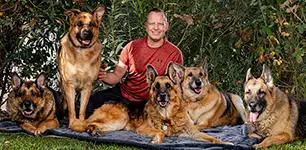
- Ralf Weber is a Training without Conflict™ Certified Professional Dog Trainer (TWC-CPDT) with over 20 years of experience and more than 1,600 dogs trained across all breeds, ages, and behavior challenges, offering services in San Diego County.
- Our training system is play-based and motivation-focused, creating reliable, real-world obedience without depending on constant food bribery or harsh corrections.
- We offer board & train programs, private in-person training, virtual coaching, and hybrid programs for puppies and adult dogs for obedience training and challenging behavior issues throughout Greater San Diego.
- Our philosophy is “relationship first,” prioritizing trust, emotional balance, clear communication, and engagement before focusing on obedience commands.
- Ready to transform your dog’s behavior? Schedule a free consultation call to discuss your dog’s specific goals and challenges.
Why Work With a Professional Dog Trainer in San Diego?
Training your dog to perform basic ‘sits’ or ‘downs’ isn’t rocket science. Many YouTube videos teach the basics with food. You won’t need a professional dog trainer for that. However, reliable behaviors require more expertise. Hiring a professional dog trainer will make a big difference, avoid a lot of frustration, and wasted money when reliability in the real world matters or you’re dealing with a behavioral issue.
Common Local Behavior Issues We See Include:
- Leash reactivity along the Embarcadero and busy sidewalks
- Overexcitement at dog beaches and off-leash parks
- Excessive barking in condos and apartments
- Separation anxiety in downtown living situations
- Door dashing in multi-family housing
- Fearful behaviors in rescue dogs
- Aggressive behaviors in various forms (towards dogs or humans)
- And many others.
Reactivity in dogs, often characterized by excessive barking or lunging at other dogs or people, can be a significant behavioral issue that requires targeted training to improve the dog’s emotional state, social interactions, and reduce stress. The San Diego Humane Society notes that leash reactivity is one of the most common challenges owners face, but luckily, it’s also changeable with the proper training approach. We help you understand the reasons and functions of your dog’s behavior so we can change it permanently. Don’t get stuck running around with a treat bag for the rest of your life or jerking on a training collar for years without change.
Professional dog training offers faster progress, improved safety, and a clear plan tailored to your household and your dog. We regularly work with popular San Diego breeds—Labrador Retrievers, Doodles, German Shepherds, Belgian Malinois, and small companion breeds—each with different needs. Our focus is real-life reliability at parks, patios, hikes, and kids’ sports events, not just classroom obedience.
We can help you make your dog the best version of itself without changing who they are and what makes them unique.
About Ralf Weber: San Diego’s Play-Based, Science-Driven Dog Trainer
I’m Ralf Weber, a Training without Conflict™ Certified Professional Dog Trainer (TWC-CPDT) and IACP-CDT/CDTA trainer servicing San Diego. Over the past 20 years, I’ve worked with more than 1,600 dogs across all ages, sizes, and behavior issues. I am specialized in Reliable Obedience, Building Confidence in Fearful Dogs, Resolving Aggression in Dogs, and Service Dog Training for people with disabilities.
My Credentials Include:
- Training without Conflict™ Certified Professional Dog Trainer (TWC-CPDT)
- International Association of Canine Professionals Certified Professional Dog Trainer Advanced (IACP-CDT/CDTA)
- Multiple additional certifications spanning Advanced Socialization, Cancer Detection, Service Dog Training, and more.
The TWC Certification for dog trainers has become the gold standard in dog training. It is an in-depth, college-level dog trainer program, and certification is not easy. TWC trainers undergo rigorous testing, adhere to the highest standards, and commit to continuous learning. It is easy to be confused by the myriad of acronyms dog trainers list after their names. How would you know what is good or not? When you check the TWC standards, you see the difference. This is not a mostly “Knowledge Assessed (-KA)” label. All TWC trainers had to prove their actual dog training abilities and thorough understanding of the learning science behind it, before the critical eyes of one of the best trainers in the business, Ivan Balabanov.
As a TWC trainer, my academic and practical foundations include modern learning science, ethology, evolutionary psychology, and neuroscience applied to everyday dog training. This means I understand not just what dogs do, but why they do it. Most behaviors have innate components, and all behaviors have a function. Only when a trainer understands these aspects as well is it possible to create real change or create true reliability.
TWC Trainers Understand What Drives Behavior
Far too many dog San Diego dog trainers, and sadly, also far too many veterinary behaviorists, are stuck in ancient behaviorist models from the 1960s. Too often, training approaches and treatment plans focus on limited approaches like desensitization or counter-conditioning. Of course, there is a time and place for those, but behavior is not just shaped by consequences, which is what these focus on. Generally, behavior is shaped by four aspects; all matter equally.
- Behaviorism — this is the classical model. Consequences shape behaviors. Pleasant consequences encourage behavior. Unpleasant consequences discourage behavior. This matters a lot, but it is just the first layer. E.g., a dog picks up a porcupine with its mouth and learns quickly that this was a bad idea. It will likely not do that again.
- Ethology — the genetic aspect of behaviors. Most behaviors have genetic origins. That is why we have different breeds of dogs. Each breed was shaped by selecting for a specific set of traits. All dogs’ noses are phenomenal, but none other is quite like a Bloodhound’s. All dogs stalk prey, but none other does it quite like a Pointer. E.g., if a Belgian Malinois or a Pitbull grabs and tears on your clothes, we are dealing with a genetic predisposition that can be guided differently, but we can’t countercondition those genetics out of the dog.
- Evolutionary Psychology — the functional aspect of behaviors. Most behaviors have a function. The dog wants to accomplish something by engaging in the behavior. E.g., a dog could bark and lunge at other dogs on leash because it is afraid of them and wants to make sure they can’t hurt it. This could be due to a past dog attack. This behavior can, of course, also have other causes, but that is why the function of the behavior matters a lot.
- Neuroscience — the impact of the brain state on behavior. Emotions determine how the dog perceives a situation, and that perception, in turn drives behavior. E.g., of course, we can apply proper consequences to a leash-reactive dog and suppress the behavior in that moment (the Behaviorism way). However, if we don’t want to keep doing that for the rest of the dog’s life, we have to change how the dog feels about other dogs. Understanding how the brain works allows us to change the perception and remove the necessity for the dog to act.
My Approach is Different
When you realize which aspects affect and drive behavior, it often becomes clear why what you have tried didn’t work well or didn’t lead to lasting change. Schedule a free consultation call today to discuss your dog’s specific goals and challenges.
My approach is highly engaging and motivating. Play-based training fulfills dogs more and eliminates the need for continuous food rewards. Dogs learn to love the work itself, become eager to work, emotionally balanced, and more reliable in real-world situations. I encourage you to watch some of the training videos on our YouTube channel to see San Diego dogs progressing through training and enjoying the process.
Our Training Philosophy: Relationship, Fulfillment, Motivation, Obedience
Our core philosophy is simple: relationship, motivation, and emotional state come before commands. In high-distraction environments in San Diego, a dog who trusts you and wants to work with you will outperform a dog who only complies when treats are present.
We build genuine motivation by tapping into the dog’s genetic drives, developing a custom game, and ensuring clear communication. The dog wants to work because the process itself is rewarding, not because they’re being bribed. Our dog training programs for San Diego specialize in science-based methods to build reliable obedience, address behavioral issues, and build trust.
As mentioned above, our methods don’t just focus on your dog’s behavior. Obviously, the behavior is important as it was shaped by its consequences, but we also understand the ethological relevance of your dog’s innate genetics influencing that behavior. In addition, we analyze the function your dog’s behavior serves and how neuroscience has shaped our understanding of how that behavior was learned, stored, why it keeps resurfacing, and how we can change your dog’s way of looking at the problematic situation.
Many trainers remain solely focused on the original reinforcement and punishment models from the 1960s. But truly addressing behavioral challenges or creating reliability requires going beyond (not ignoring) that model and factoring in ethology (innate aspects), evolutionary psychology (function), and neuroscience (emotions, brain state, learning, etc.) into the equation.
This philosophy is especially powerful for fearful, anxious, or aggressive dogs that struggle in typical group classes or chaotic environments. When dogs are in the right state of mind, are motivated, and feel safe and secure, everything else becomes easier.
Dog Training Programs We Offer For Greater San Diego
All our training programs are customized following an initial evaluation (virtual or in-person) and can be combined to meet your needs. Dog training services for San Diego typically include private sessions and specialized board-and-train programs tailored to the needs of individual dogs and their owners.
The cost of dog training can vary widely depending on the type of program, with options including in-person, board-and-train, and virtual sessions. Depending on your situation, pricing can be determined during our free phone consultation or may require an in-person meeting.
Board & Train Programs: Dogs stay with us for intensive professional dog training, receiving multiple sessions per day with daily engagement and play.
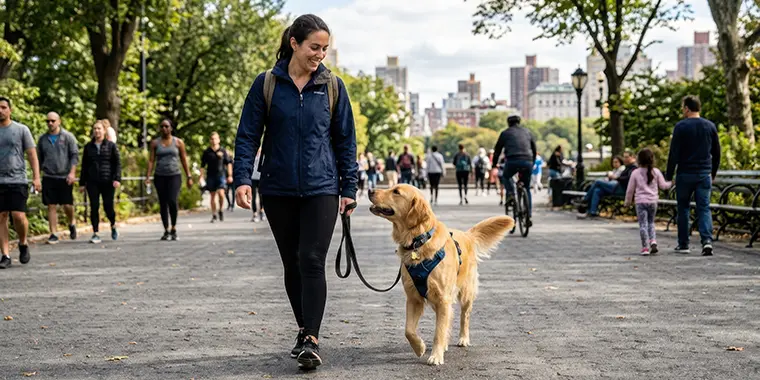
Private In-Person Training: Sessions are held at our or local public locations (neighborhood walks, local parks, patios) to address real-world behavior issues.
Virtual Lessons and Coaching: Ideal for out-of-area clients, follow-ups after Board & Train, or owners wanting coaching for their training.
Workshops and Lectures: In addition to dog training, I am available to lead one of our fun, engaging dog lectures on any topic of your choosing in San Diego and the surrounding areas.
All formats are suitable for puppies, adolescent dogs, adult dogs, and senior dogs with new or long-standing behavior problems. Schedule a free consultation call today to discuss your dog’s specific goals and challenges.
Board & Train for San Diego: Immersive, Play-Based Learning
Board & Train programs involve intensive training in which the dog stays with the trainer and are suitable for behavioral challenges and obedience training. Many busy San Diego families—whether dealing with travel, military deployments, or demanding careers—choose this option because it delivers rapid, immersive progress.
Relationship First — We spend the first week or so becoming your dog’s trusted friend. We only move forward once your dog is in the right emotional state and has the proper motivation to learn.
Program Length — Typical programs range from 6 to 8 weeks, depending on goals and behavior issues. Severe aggression or anxiety may require longer durations. Our programs are longer than what you see elsewhere, because we first spend time building a relationship with your dog and becoming friends. Everything becomes easier from there.
Board & Train Visits — We want you to visit your dog during the training program. Typically, visits are at week 3 or 4 and again at week 5 or 6. The visits serve several purposes. First, it’s a longer process, and we know you will miss your friend. Second, it shows your dog that this is something you are part of and not just something it did on its own. Third, the visits are part of the post-training transition. Each visit focuses on you learning something new that your dog now knows.
Post-Training Support — All our Board & Train programs include lifetime support. By the time your dog returns home, you will already have some new skills from the transition sessions held earlier. In addition, you will receive detailed written transition instructions and video demos for what you need to know. Especially for behavioral cases, the first 4-5 weeks back home are critical as some of the finishing touches need to be practiced in your environment. For obedience programs, it is essential to keep practicing for a few weeks so your dog knows you expect the same behaviors he learned with us.
A Day in Training — Your dog experiences multiple play-based training sessions, rest periods, exposure to real-life scenarios, and careful emotional management throughout the day.
Video Updates — You’ll receive weekly videos showing your dog’s progress. Share these with family and start learning the handling techniques you’ll use at home later.
Graduation and Transfer — Every program includes a transfer session with ongoing support, so skills carry over into your San Diego home and routine.
Private Dog Training for San Diego: Personalized Help Where You Need It Most
One-on-one training sessions are ideal for targeted problems or pet owners who want to be deeply involved in each step of training. Private dog training sessions generally offer personalized instruction and can vary in cost depending on the dog’s specific needs.
Common Goals We Address:
- Improved relationship between your dog and family members
- Stopping aggressive behaviors around the house or neighborhood
- Better leash manners around Balboa Park
- Reliable recall at Fiesta Island
- Calm behavior at dog-friendly patios in North Park or La Jolla
- Greeting guests politely without jumping
- No lunging at other dogs on walks
- Many more
Behavior issues we commonly work with include jumping, barking at neighbors, door dashing, leash pulling, reactivity to other dogs and people, resource guarding, aggression, and fear responses.
Private training can be scheduled weekdays and select weekends to accommodate busy San Diego work and family schedules.
Virtual Coaching & Owner Education
Virtual dog training works surprisingly well for many dog owners, especially for coaching fearful dogs that do best in their familiar environment. Sessions take place via Zoom, with owners demonstrating exercises while I provide step-by-step feedback, or I demonstrate exercises with another dog on my end. Should your dog not be up for training during our scheduled time, I will teach you what to do, you record your next session, and I provide feedback once you upload your video. We’ll get it done, one way or another!
Virtual Coaching is Particularly Helpful For:
- Obedience Foundations: You learn to do things correctly from the start.
- Fearful Dogs: Insecure dogs do best in familiar settings with their team.
- Busy Schedule: You need expert support, but don’t have time to drive far.
- Remote Location: You need expert support, but don’t have the right trainers locally.
- Consistency: You need a training guide to stay on track.
This format allows San Diego dog owners to stay consistent even when traveling, deployed, or working irregular hours. Videos recorded during calls can be downloaded as a reference for continued practice.
San Diego Puppy Training: Starting Right From Day One
The first 4 months shape a pup’s life more than any other period. Getting this early time right is critical. While many behaviors can be addressed and changed in adult dogs, some, formed during this critical, social development period, can’t. What we do early on sets the tone for years. Don’t wait! Establish good habits early, during the critical window.
Core Puppy Skills We Teach:
- Safe and correct socialization before all puppy shots are complete—too many veterinarians still give poor advice
- Building the right relationship and motivation for training from day one
- Developing confidence in your young and impressionable puppy from the start
- Reliable recall foundation
- Potty training for apartments and homes
- Crate training
- Dealing with chewing and biting
- First leash skills and loose-leash walking foundations
- Handling exercises to prepare for vet visits and groomers
- And many more
Many dog training programs emphasize the importance of socialization and consistency at home for puppies and adult dogs alike. We go beyond that. At Happy Dog Training, we help you socialize safely and correctly, build your dog’s confidence, and lay the foundation for a lifetime of happy dog companionship.
We teach owners how to play correctly with their new puppy to build the best relationship and create the right motivation for obedience training; it’s not just to drain energy. We help you channel your dog’s drives and genetics into healthy outlets. It keeps your pup fulfilled and helps prevent bad behaviors from developing.
Addressing Behavior Issues: From Leash Reactivity to Aggression
If your dog has been labeled “difficult” or “hopeless” by others, know that serious behavior issues are common and often very treatable with the correct training approach. We routinely work with dogs that have been turned away elsewhere. In many cases, I am the trainer of last resort after other common approaches failed to produce lasting results.
Issues We Frequently Handle:
- Leash reactivity on busy San Diego streets
- Aggressive behavior towards dogs, people, or even family members
- Resource guarding
- Minor insecurities to severe generalized fear
- Self-mutilation (e.g., paws, tail, body, etc.)
- Destructive behaviors around the home and yard
- General mischievous behaviors (e.g., stealing socks, countersurfing, etc.)
- And many more
Far too many dog San Diego dog trainers, and sadly, also far too many veterinary behaviorists, are stuck in ancient behaviorist models from the 1960s. Too often, training approaches and treatment plans focus on limited approaches like desensitization or counter-conditioning. Of course, there is a time and place for those, but behavior is not just shaped by consequences, which is what these focus on.
The TWC or Training without Conflict approach feels like a breath of fresh air for our clients. Many have been to multiple San Diego dog trainers before, only to hear the same old tropes: use higher-value treats, be a leader, use this-or-that tool, e-collars will fix it all, positive reinforcement is the only way, your dog needs medication, walk your dog more, and so on. Our approach is not an ideology but rooted in understanding how dogs learn and what all affects behavior in the first place.
Behavior is Shaped by Four Aspects — All Matter Equally.
- Behaviorism — this is the classical model. Consequences shape behaviors. Pleasant consequences encourage behavior. Unpleasant consequences discourage behavior. This matters a lot, but it is just the first layer. E.g., a dog picks up a porcupine with its mouth and learns quickly that this was a bad idea. It will likely not do that again.
- Ethology — the genetic aspect of behaviors. Most behaviors have genetic origins. That is why we have different breeds of dogs. Each breed was shaped by selecting for a specific set of traits. All dogs’ noses are phenomenal, but none other is quite like a Bloodhound’s. All dogs stalk prey, but none other does it quite like a Pointer. E.g., if a Belgian Malinois or a Pitbull grabs and tears on your clothes, we are dealing with a genetic predisposition that can be guided differently, but we can’t countercondition those genetics out of the dog.
- Evolutionary Psychology — the functional aspect of behaviors. Most behaviors have a function. The dog wants to accomplish something by engaging in the behavior. E.g., a dog could bark and lunge at other dogs on leash because it is afraid of them and wants to make sure they can’t hurt it. This could be due to a past dog attack. This behavior can, of course, also have other causes, but that is why the function of the behavior matters a lot.
- Neuroscience — the impact of the brain state on behavior. Emotions determine how the dog perceives a situation, and that perception, in turn, drives behavior. E.g., of course, we can apply proper consequences to a leash-reactive dog and suppress the behavior in that moment (the Behaviorism way). However, if we don’t want to keep doing that for the rest of the dog’s life, we have to change how the dog feels about other dogs. Understanding how the brain works allows us to change the perception and remove the necessity for the dog to act.
When you realize which aspects affect and drive behavior, it often becomes clear why what you have tried didn’t work well or didn’t lead to lasting change. Schedule a free consultation call today to discuss your dog’s specific goals and challenges.
Customized Training for All Dogs
We don’t use a one-size-fits-all training approach. All dog breeds are different. All dogs are individuals.
Key Factors Affecting Training
Characteristics: We consider your dog’s age, previous history (shelter, rescue, breeder), and San Diego lifestyle—apartment versus house, kids in the home, other pets, and so on. The better we understand your dog and your living situation, the better we can help you.
Training Goals: We will give you an honest assessment of what we believe can realistically be achieved with your dog in your circumstances. Of course, we all want to hear that all our dreams will come true, but sometimes our goals aren’t realistic for a particular dog (i.e., especially a fearful one). We draw on 20+ years of experience and will be straightforward about what we believe is fair to your dog and achievable. For example, we can typically stop a dog from acting out on leash when walking towards other dogs, but we may not be able to get him to like other dogs. What is possible depends on the behavior’s reason and function.
Instincts vs Environment: Some behaviors can simply be stopped, but many others must be guided towards more appropriate outlets. Just suppressing whatever bothers us can easily become a game of wack-a-mole. What I mean by that is that suppressing one undesirable behavior leads to a new undesirable behavior popping up out of nowhere, a few weeks later. This occurs when the behavior serves a function or fulfills a biological need that is otherwise missing. We need to guide that biological need into an appropriate outlet to stop related undesirable behaviors for good.
Reliability: We teach you how to make all commands reliable in your San Diego environment. For example, teaching a dog the mechanics of a ‘sit’ or ‘down’ command is fairly straightforward. Watch a few YouTube videos, and you’re good to go. But making your dog hold that down when its favorite toy is flying over its head or its favorite person walks into the room is a whole other ballgame. We teach you the principles of reliability world champions in dog sports use to take the prize. Your dog can be a San Diego coffee shop companion, too. Let us show you how to get there.
Our training adjusts to match each individual dog.
Real-World Results: What Our San Diego Clients Experience
The transformations we see with local clients go beyond basic obedience. Dogs who once caused chaos on walks become calm, responsive companions. Owners who dreaded public outings now enjoy exploring San Diego with their dogs.
Sample Transformations:
- A German Shepherd from Pacific Beach with severe leash reactivity now walks calmly near other dogs and enjoys beach-access paths.
- A small companion dog in a downtown condo who barked at every elevator door and neighbor now settles quietly at home.
- A rescue doodle from La Mesa, who jumped on every guest, now greets visitors politely without jumping.
Owners report not just better obedience but noticeable changes in their dog’s confidence, relaxation at home, and overall relationship quality. Many describe a huge improvement in their daily life with their dog.
Clients receive private YouTube playlists showing their dog’s progress, available anytime for reminders and motivation. I encourage you to watch public training clips online to evaluate our methods and results for yourself.
How We Support You Throughout the Training Process and Beyond
We work with both ends of the leash—training the dog and coaching the owner. Lasting results depend on building your knowledge and confidence as a handler. We listen to our clients because we want to understand your dog and the details of your challenges. From what our clients tell me, this has somehow become unusual.
Support Includes:
- Initial consultation (typically 30 minutes) to understand your dog’s background and your training goals.
- Weekly video updates during board-and-train programs.
- Demo training videos for key homework and practice sessions for reference.
- Check-ins to address questions.
- Multiple transition training sessions for board-and-train programs while your dog is still with us.
- All board-and-train programs come with lifetime support.
- For virtual training, between-session client training video reviews and feedback.
Our long-term goal is to give owners the dog skills and confidence to maintain their dog’s behavior for years, not just weeks. Through expert guidance and ongoing support, stronger bonds develop naturally.
Service Area: Where We Train Dogs in and Around San Diego
Most of our clients in San Diego County come from San Diego, San Marcos, Solana Beach, and Escondido, but all others are welcome.
Virtual coaching is available to clients anywhere, including outside San Diego County and Southern California, across the country, and globally.
What to Expect When You Contact Us
After you fill out our contact form, here’s what happens:
- You can view our calendar and schedule a free phone consultation on a day and at a time convenient for you.
- During this 30-minute, in-depth phone conversation, we discuss your challenges, goals, and how I can best help you.
- If I need more information, I will offer you a free in-person consultation to better understand your dog.
- We will review your dog’s behavioral history and background, including your dog’s age, breed, medical history, incident details, and routines.
- We will discuss your training goals and what success looks like for your specific situation.
- I will recommend the optimal dog training program and format for your situation.
We’ll discuss any previous training experiences—including methods used, current challenges, and your typical schedule. At the end of our phone consultation (or, when necessary, in-person consultation), you’ll receive transparent information about pricing, expected duration, and realistic outcomes.
Every dog deserves to feel confident and secure. Every owner deserves a dog they can trust in real-world situations.
Schedule a free consultation call today and start transforming your dog’s behavior and your relationship together.
Frequently Asked Questions About Dog Training in San Diego
How long does it usually take to see results?
Many San Diego clients notice meaningful improvements—like calmer walks or reduced jumping—within the first few sessions when they follow the plan consistently. More complex behavior issues, such as aggression, severe fear, or long-standing habits, may require several weeks or months of consistent work. Training is a process, not a one-time event, and we design realistic timelines based on each dog’s history and training goals. New behaviors typically become reliable through systematic practice grounded in the principles of learning science.
Do you use treats, toys, or corrections in your training?
Our approach is relationship-focused and motivational. Our primary reward mechanism is play but also includes praise, and sometimes food—but does not depend on constant bribery. The priority is building a stronger relationship between you and your dog, creating a high level of motivation and clear communication, so your dog works happily without food present. Any tools or techniques used are carefully chosen for each dog, always with the goal of emotional balance, clarity, and safety. My Training without Conflict (TWC) certification demonstrates my expertise in a multitude of training methods and a wide range of behavioral issues.
Is Board & Train or private training better for my dog?
Board & Train is ideal for busy owners or dogs needing an immersive reset with intensive daily training sessions. Private sessions are great for hands-on owners and home-specific behavior issues, where in-home practice makes the most difference. For serious aggression or complex multi-dog conflicts, we often combine Board & Train with private sessions for the best results. Book a consultation so we can recommend the most effective path for your dog’s behavior and your schedule.
Can you help with potty training and house manners?
We regularly help San Diego puppy and adult-dog owners with crate training, chewing, and household rules. Success depends on consistent routines, clear communication, and owner follow-through—we provide clear, step-by-step guidance tailored to each home. Both in-person training and virtual coaching work very well for house manners, making them accessible options for any San Diego County resident. Potty training is best accomplished in your home, as the dog ultimately needs to learn where to go, and that is unique to your location. Follow our free step-by-step potty training guide to get your dog house-trained in no time. This is an excerpt from my book If Your Dog Could Talk—Understand Your Dog Like Never Before (5th Edition).
Do you work with reactive or aggressive dogs that other trainers have turned away?
I specialize in working with fearful, reactive, and aggressive dogs, including large-breed dogs like German Shepherds and protection-type breeds. Due to my extensive experience and my TWC certification, I am often the trainer of last resort for aggression cases turned away by others and even recommended for euthanasia by other trainers. I thoroughly evaluate each dog and provide you with my best assessment of a realistic outcome. We have kept many families together over the years and saved many dogs. Don’t despair! Let us help you. Many of our most rewarding success stories come from dogs whose owners had almost given up before finding our relationship-first, play-based approach. These animals often show remarkable transformation when given proper support and understanding.